


Where Should You Place a Lamp to Reduce Screen Glare?

In this article
Place a task lamp beside the monitor and aim its light at the work surface, not at the screen or your eyes. For handwriting, put the lamp on the side opposite your writing hand to reduce shadows. The best position keeps the bulb outside your direct field of view and prevents a bright reflection from appearing on the display.
A lamp behind the monitor can soften the contrast between a bright screen and a dark room, but it should not shine toward the screen. A lamp directly in front of the display is more likely to reflect back at you. The right answer depends on whether you need light for documents, video calls, or general room brightness.
Start with the source of the glare
Screen glare can be direct or reflected. Direct glare comes from a bright source in your field of view, such as an exposed bulb. Reflected glare appears when light bounces off a glossy screen, desk, framed picture, or window. Moving a lamp without identifying the type of glare can simply move the bright spot.
CCOHS recommends controlling glare through lighting design and monitor placement. Its guidance notes that a monitor is already a light source and usually does not need extra illumination. A soft task light is useful for paper documents, but it should illuminate the document rather than the display.
Best lamp position for most computer work
For a typical desk, begin with the lamp to the left or right of the monitor, slightly forward of the screen plane. Aim the shade downward and across the desk. This keeps the beam on the keyboard, notebook, or printed page while reducing the chance that the bulb or its reflection reaches your eyes.
If you write by hand
Right-handed users often get fewer shadows with the lamp on the left. Left-handed users can reverse the arrangement. This is a useful starting point, not an absolute rule. A tall lamp, monitor arm, second screen, or nearby wall can change the path of light.
If you mostly read from the screen
Use lower-intensity ambient light and keep the task lamp dim or directed away from the display. The goal is moderate contrast. A bright screen in a dark room can feel harsh, while a bright lamp pointed at the monitor can wash out text and create reflections.
Should the lamp go behind the monitor?
Indirect light behind a monitor can make the surrounding wall less dark and reduce the visual jump between the screen and background. It works best when the source is hidden from view and the light spreads across the wall. It is not a replacement for task lighting when you need to read paper.
A conventional desk lamp behind the monitor can cause problems if the shade or bulb protrudes above the screen or if the beam strikes the display. If you use that position, point the lamp toward a matte wall and check the screen from your normal seated and standing positions.
Where a floor lamp can work
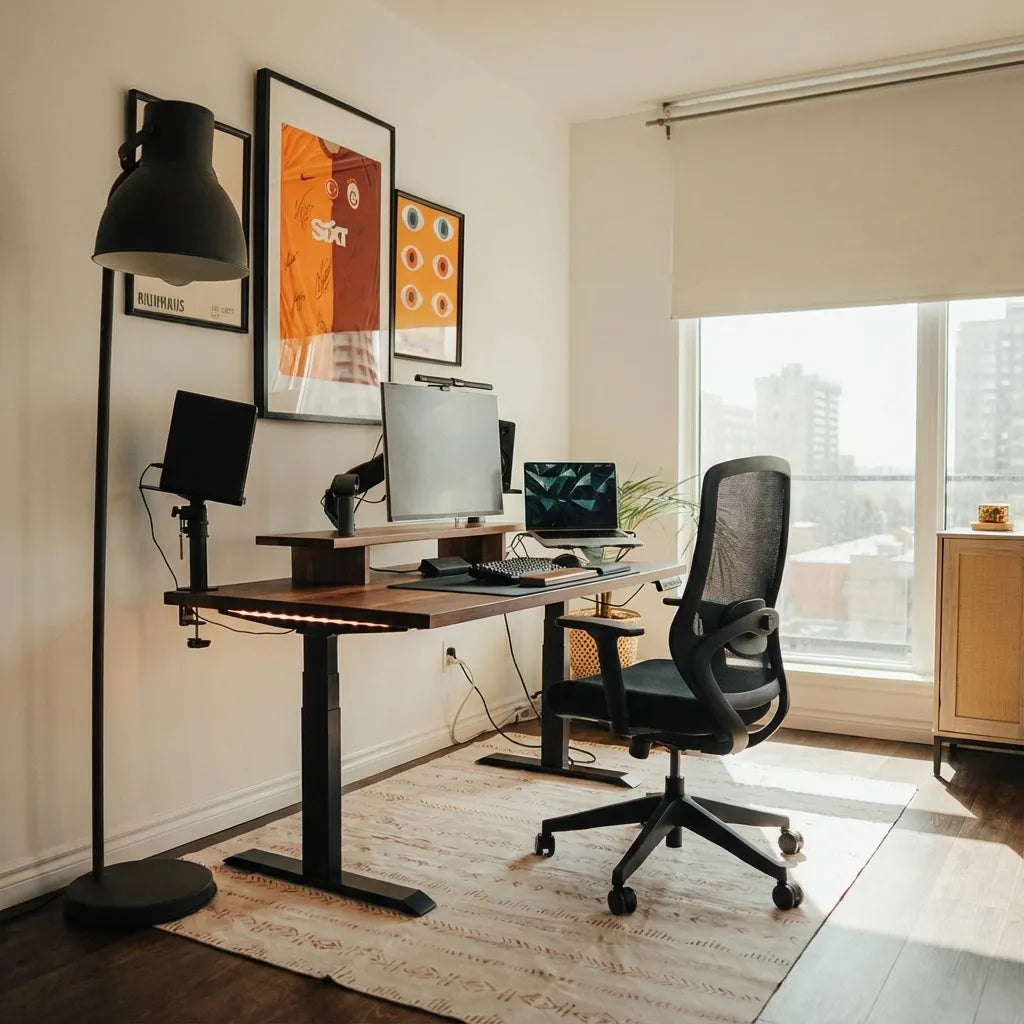
A floor lamp beside the desk can provide useful indirect or task light without occupying the desktop. Keep its shade above or to the side of eye level, and aim it down at the work surface or toward a wall. Avoid placing an exposed bulb directly behind the monitor where it enters your line of sight.
The featured Burotic photo shows a black floor lamp beside a wood desk, with multiple screens, a laptop, a black mesh chair, framed art, a rug, and a bright window. The lamp is clearly separate from the desktop. The image is an example of a complete room layout, not proof that one fixed lamp position will suit every screen finish or window orientation.
Run a two-minute glare test
- Sit in your normal working position and display a dark grey or black screen.
- Look for a visible lamp, window, or bright object reflected in the panel.
- Turn the lamp off. If the reflection disappears, the lamp position or angle is the cause.
- Move the lamp sideways, lower its output, or aim it at the desk rather than the screen.
- Repeat the test while standing if you use a height-adjustable desk.
CCOHS also suggests using a small mirror on the work surface to detect overhead reflections. If the mirror shows a light fixture, that fixture may be contributing to glare on glossy surfaces.
Coordinate the lamp with windows and ceiling lights
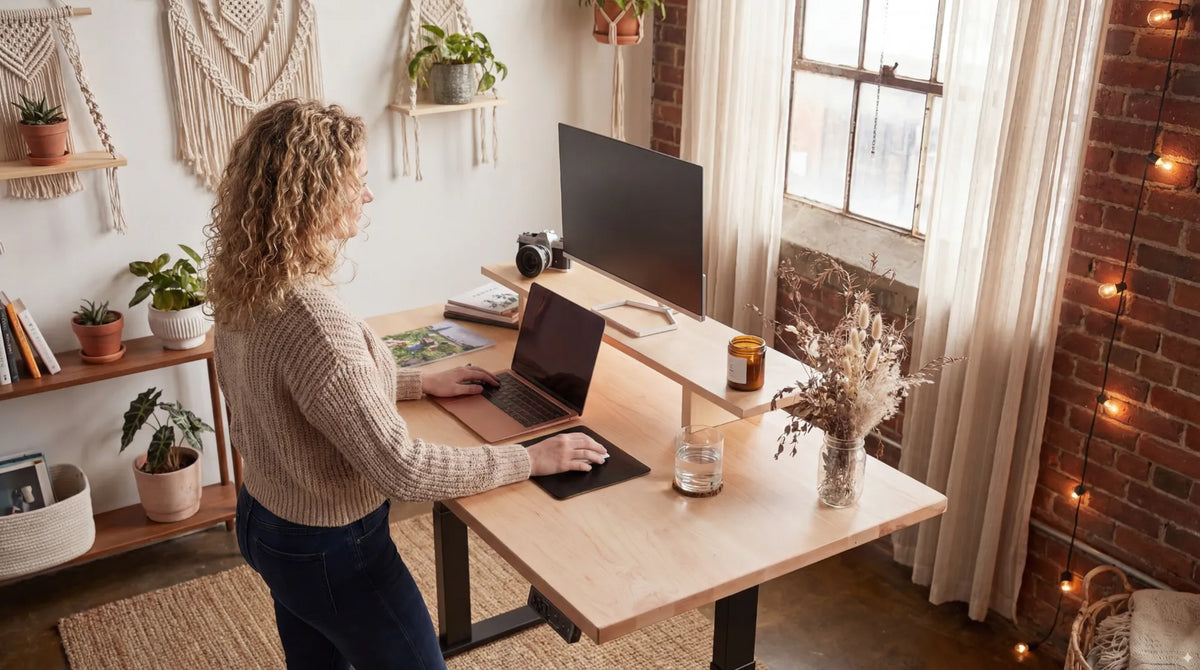
A good lamp cannot fully correct a workstation that faces a bright window or sits directly under a harsh fixture. Position the monitor so windows and rows of ceiling lights are generally parallel to your line of sight rather than directly in front or behind the display. Adjustable blinds help manage changes through the day.
If a window is the main problem, read our guide on whether a monitor should face a window. For a broader daylight plan, see natural light without screen glare.
Use brightness and surface finishes wisely
Match screen brightness to the room instead of simply setting it to maximum. Matte desk surfaces, walls, and accessories usually create fewer sharp reflections than glossy finishes. Clean the display, since fingerprints and haze can scatter light and reduce clarity.
Do not solve every lighting issue with an anti-glare filter. CCOHS notes that anything placed between the user and the screen can compromise image quality. Start with the lamp angle, monitor orientation, blinds, and brightness settings.
Keep the lamp clear of monitor adjustments
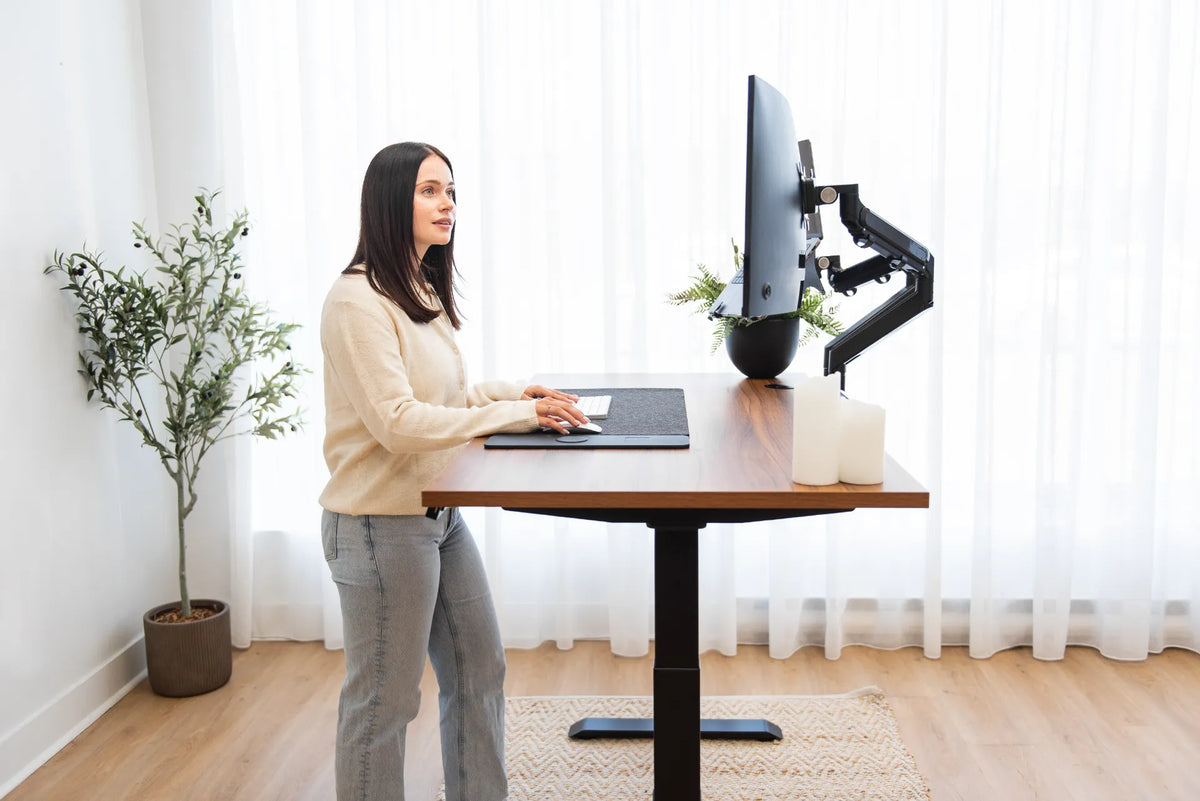
If the display is mounted on an arm, leave room for it to move without striking the lamp. Check the arm through its full height, tilt, and swivel range. The Burotic monitor arm can free desktop space and help adjust screen position, but lamp clearance still depends on the selected configuration and desk layout.
On a sit-stand workstation, attach no loose lamp cable where it can pull as the desk rises. Route cords with enough slack for the full travel and keep them away from the legs and feet. Browse Burotic's office accessories for compatible ways to organize a workstation without overloading the surface.
Choose controllable light instead of maximum output
An adjustable shade and dimmer are usually more useful than raw brightness. They let you change the beam for handwriting, screen work, and evening use without moving the whole desk. If the lamp has a visible bulb, add diffusion or reposition the shade so the bright point is hidden. Colour appearance is a preference, but large differences between a very cool screen and very warm room light can make the workstation feel visually uneven. Make one change at a time and judge it from your normal working position.
Bottom line
Place a task lamp beside the monitor, outside your direct line of sight, and aim it at the work surface. Put it opposite your writing hand when shadows matter. Use indirect light behind the screen only to balance the background, and never point a bright beam at the panel.
Test the setup from the actual position where you work. A five-centimetre move, a lower brightness setting, or a change in shade angle can be more effective than buying a stronger lamp.
Previous article
How Far Should You Sit From a Laptop Screen?
Next article
How Far Should You Sit From a Laptop Screen?