





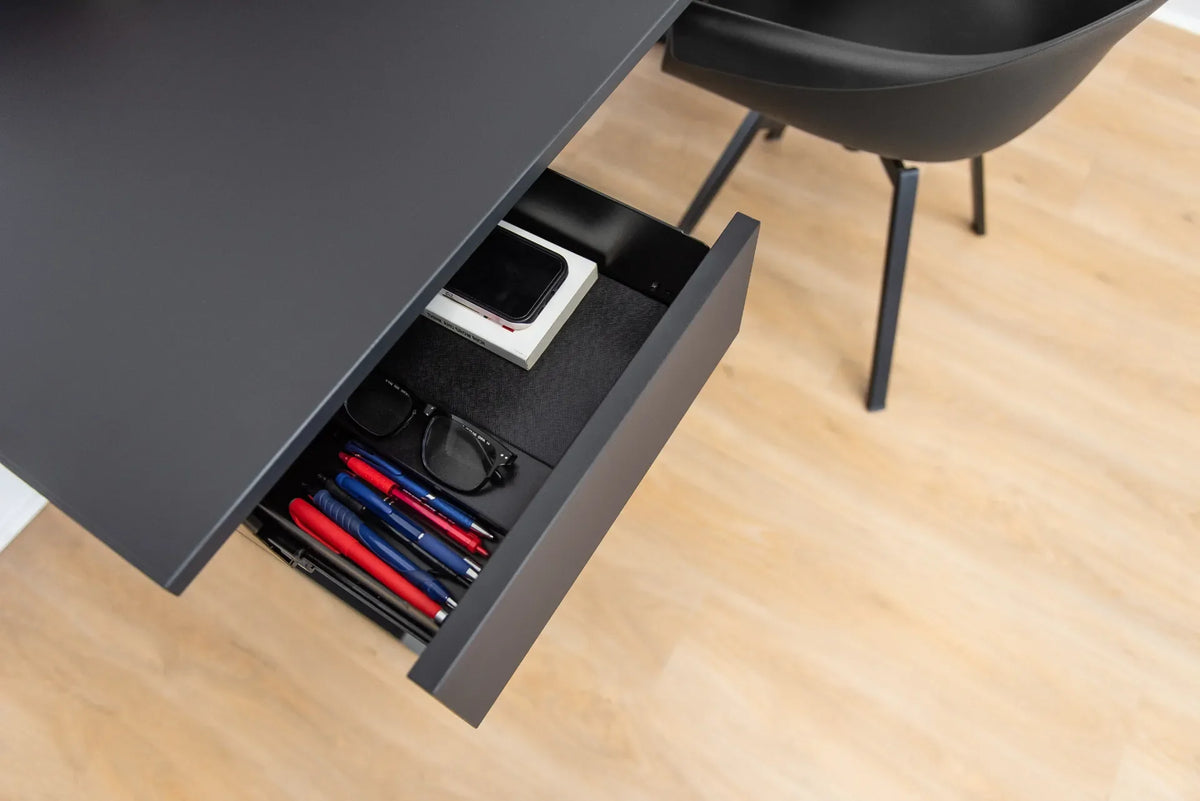
How to Organize a Shallow Desk Drawer

In this article
A shallow desk drawer works best when every item fits below the drawer opening, has a defined place and supports a task you actually do at the desk. Start by measuring the usable interior, not the outside of the drawer. Then choose low-profile organizers and reserve the easiest-to-reach area for daily tools.
The goal is not to fill every centimetre. A well-organized shallow drawer should open smoothly, let you see most contents at once and make it easy to return an item with one hand. Leaving a little open space is often more useful than adding another compartment.
Quick answer: measure, edit and zone
- Empty the drawer and clean it according to the manufacturer's instructions.
- Measure interior width, depth and usable height.
- Remove supplies that belong elsewhere.
- Group the remaining items by task and frequency of use.
- Test low-profile trays before committing to a layout.
- Keep daily items near the front and occasional items toward the back.
This sequence prevents the most common mistake: buying an organizer that fits the drawer footprint but is too tall for the drawer to close.
Measure the usable space correctly
Measure inside the drawer box
Use a tape measure inside the drawer from side to side and front to back. Do not rely on the desktop width or the drawer's exterior face. Hardware, rounded corners and side rails can reduce the usable interior.
Record the narrowest width and the shortest depth if the drawer is not perfectly rectangular. If a screw head, latch or cable enters the space, treat that obstruction as part of the measurement.
Check usable height with the drawer installed
Height is the critical dimension in a shallow drawer. Measure from the bottom to the lowest obstruction above it. The opening may be lower than the inside of the drawer, so an organizer can fit once placed inside but still catch when the drawer closes.
Test the height with the tallest item you plan to store. Close the drawer slowly the first time. Pens with clips, stacked sticky notes and bulky charging adapters often need more clearance than expected.
Leave room for movement
An organizer should not be wedged tightly against every side. A small amount of clearance makes it easier to remove the tray for cleaning and accommodates minor differences between the front and back of the drawer. If the organizer slides, secure it with a removable, surface-safe solution recommended for both materials.
Decide what belongs in a shallow drawer
A shallow drawer is ideal for small, flat items used at the workstation. Examples include a few pens, a pencil, a small ruler, sticky notes, a charging cable, glasses, a compact calculator or a notebook that fits without bending. The exact list should match your work rather than a generic office-supply checklist.
Avoid turning the drawer into overflow storage. Large adapters, heavy tools, liquids, food and stacks of paper usually fit better elsewhere. If an item is rarely used, it does not need prime space directly under the desk.
For a broader sorting method, see Burotic's desk drawer organization guide. If you are still choosing the storage format, compare under-desk storage ideas for a small office.
Build zones around your actual tasks
Front zone: daily reach
Place the tools you reach for several times a day near the drawer opening. That may be one writing tool, sticky notes and a charging cable. Keeping the front zone simple reduces rummaging and helps you notice when an item has not been returned.
CCOHS recommends arranging work materials according to importance and frequency of use. Applying the same principle inside the drawer keeps frequent tools within easy reach and reduces unnecessary bending or searching.
Middle zone: task kits
Group items used together. A note-taking kit might include a pen, highlighter and small ruler. A device kit might include one cable and the adapter you actually use at the desk. A paper-handling kit might include clips and a compact stapler if the drawer has enough height.
Task grouping is often more durable than sorting every item only by type. When you begin a task, the necessary tools are together. When you finish, the whole group has a clear home.
Back zone: occasional items
The back of a shallow drawer is harder to reach and see. Use it for occasional supplies, such as replacement lead, an extra cable or a small cleaning cloth. Avoid placing tiny loose pieces directly in the back corners, where they are likely to disappear.
Choose low-profile organizers
Look for trays that are visibly lower than the measured opening. Modular pieces can be useful because they let you create one long compartment for writing tools and smaller compartments for clips or adapters. A single fitted tray can look tidy but may waste space if its fixed sections do not match your supplies.
Transparent, light-coloured or open organizers make contents easier to see. Dark organizers can still work well when the items have contrasting colours. What matters is quick recognition, not a particular aesthetic.
Before removing packaging or adhesive backing, place the empty organizer in the drawer, add the tallest item and close the drawer gently. Then open it fully and confirm the tray does not block the drawer mechanism.
Protect legroom and desk movement
An under-desk drawer occupies space below the desktop. Confirm that it does not interfere with your thighs, knees, chair arms or standing desk frame. Sit in your normal working position, move the chair toward the desk and raise the desk through its intended range.
Do not overload the drawer. Follow its stated capacity and installation instructions. A drawer that sags or shifts can affect clearance and operation. For installation planning, use the guide on installing an under-desk drawer without losing legroom.
The active Burotic Desk Drawer page provides current product details. Verify dimensions against your own desktop, frame and seated clearance before purchase or installation.
Common shallow-drawer mistakes
Buying organizers before measuring
Footprint is only part of the fit. The organizer and the items inside it must clear the opening. Always measure usable height and test the tallest stored item.
Stacking to create more capacity
Stacking hides lower items and can prevent the drawer from closing. In a shallow drawer, one visible layer is usually the most practical approach.
Keeping every spare at the desk
One working pen and one backup may be useful. A large supply of duplicates consumes space and makes the drawer harder to scan. Store bulk supplies in a separate cabinet or box.
Mixing unrelated items
Loose coins, personal care items, hardware, food and office supplies quickly create clutter. Assign each drawer a clear purpose. If an item has no connection to desk work, give it another home.
Ignoring cables
Coil cables loosely and avoid sharp bends. Keep connectors visible so you can identify them without pulling out the entire compartment. Do not store damaged cables or batteries in a drawer.
A five-minute weekly reset
- Return items to their assigned compartments.
- Remove cups, wrappers and objects that migrated from elsewhere.
- Test pens and recycle or dispose of unusable supplies appropriately.
- Wipe the organizer if needed, following material care directions.
- Leave one open area for temporary items during the next workweek.
A short reset works because the drawer already has a simple structure. If the same item repeatedly ends up in the wrong place, change the layout. The system should match your behaviour rather than require constant discipline.
Bottom line
To organize a shallow desk drawer, measure usable height first, keep only task-relevant items and use one visible layer of low-profile compartments. Put daily tools at the front, group related supplies in the middle and reserve the back for occasional items. A little empty space makes the drawer easier to use and maintain.
The best layout is the one you can reset quickly. Start with fewer items, work for a week and adjust the zones based on what you actually reach for.


Previous article
How Thick Should an Anti-Fatigue Mat Be for a Standing Desk?
Next article
Where Should You Put a Desk in a Square Room?