

Under-Desk Drawer vs. Filing Cabinet: Which Storage Fits Your Workspace?

In this article
Good office storage reduces visual clutter without pushing useful items out of reach. Two common solutions solve different problems: an under-desk drawer keeps small daily tools attached to the workstation, while a filing cabinet adds larger, independent storage beside or beneath it. The right choice depends less on which product holds more and more on what you store, how often you reach for it and how your desk moves.
This comparison is especially important with a height-adjustable desk. Anything attached to the desktop moves with it. Anything on the floor stays fixed. That difference affects legroom, cable clearance, access while standing and the safe path of the desk.
The short answer
Choose an under-desk drawer for pens, a small notebook, glasses, adapters and other light items used throughout the day. Choose a filing cabinet for documents, bulkier supplies, locked storage or items that do not need to rise with the desktop. Many complete workspaces benefit from both, provided the cabinet remains outside the moving base and the drawer does not reduce knee clearance.
What an under-desk drawer does best
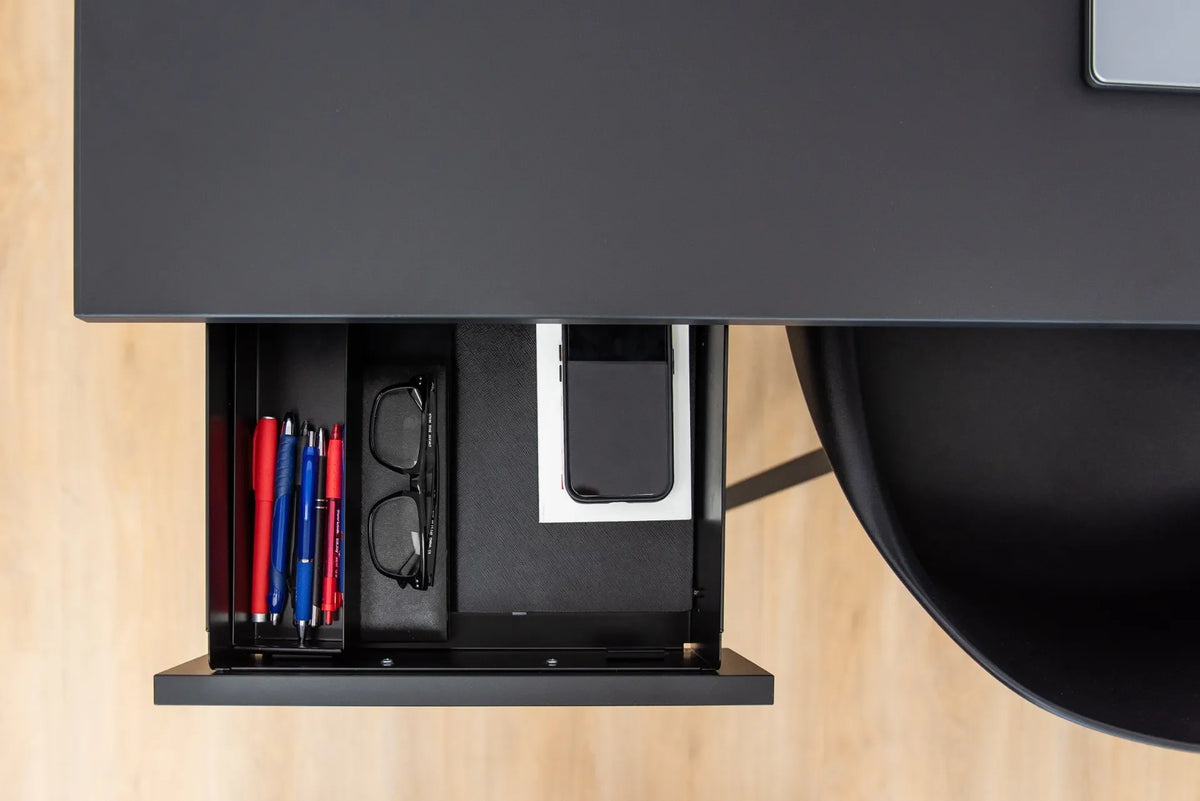
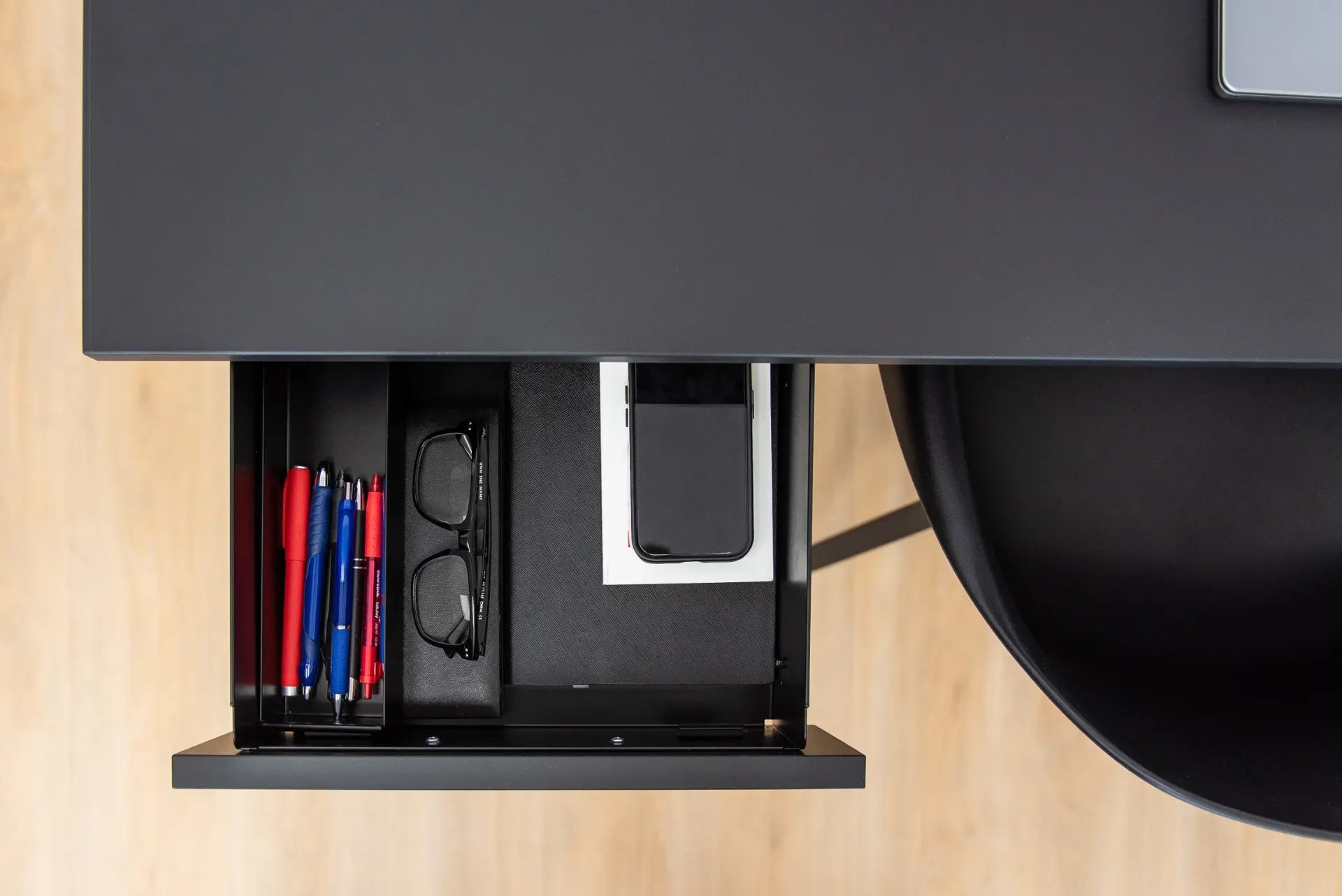
An under-desk drawer uses space immediately below the work surface. It keeps the desktop clear while placing small objects within seated or standing reach. Because the drawer moves with the desk, its contents remain at a consistent distance from the user when the height changes.
The Burotic Desk Drawer is designed to complement selected Aspire desks. Its current product page states compatibility with Aspire desks in 30 by 60 and 30 by 72 inch formats, so compatibility must be checked before purchase. An attached drawer is not a universal accessory, and the available mounting area may also be shared with a controller, cable tray or other hardware.
Best contents for a shallow drawer
- Pens, pencils, markers and a small ruler
- Eyeglasses, cleaning cloths and a compact notebook
- Frequently used adapters or a charging cable
- Sticky notes, clips and other light stationery
- Small personal items that would otherwise remain on the desktop
A shallow drawer works best when it remains selective. If every spare cable, document and supply is pushed inside, access becomes slow and the hardware carries unnecessary weight. Our desk drawer organization guide offers a practical way to divide items by frequency of use.
What a filing cabinet does best
A filing cabinet is independent of the desktop and usually provides much more volume. It is better suited to paper files, folders, reference material and supplies that are too large for a shallow drawer. It can also remain accessible when the desk is raised, as long as it is positioned beside the desk rather than trapped beneath a moving surface.
The active Burotic Filing Cabinet currently has three drawers, smooth-glide storage, a central lock and casters according to its product listing. The black and white versions are designed for office use and support common document formats. Always confirm current specifications on the product page before planning exact file capacity.
Best contents for a filing cabinet
- Client, project or household files that need folders
- Documents that benefit from lockable storage
- Printer paper, notebooks and backup office supplies
- Items used weekly or monthly rather than every hour
- Materials that should not add load to the moving desktop
Compare access, capacity and workflow
Access is where the drawer wins. A well-placed drawer opens with a small movement and keeps daily tools in the primary reach zone. A cabinet requires a larger reach or a turn, but that is appropriate for less frequent materials. The CCOHS recommends arranging equipment and work materials according to their importance and frequency of use. That principle suggests keeping high-frequency, light items close and moving archives or bulk supplies farther away.
Capacity is where the cabinet wins. A drawer should not be treated like a miniature filing cabinet. Paper stacks can jam a shallow drawer, and dense supplies may exceed its intended use. The cabinet separates storage from the desktop and can reduce the temptation to overload the moving workstation.
Protect knee and leg clearance
Any accessory installed beneath the desktop occupies space that might otherwise be available to the thighs and knees. Before choosing a drawer, sit in your normal posture and measure the vertical distance from the underside of the desktop to the top of your thighs. Test the proposed location with the chair centred, then check whether you move laterally during the day.
Do not mount a drawer where it forces you to sit off-centre or reach around it. A centred drawer may work for a wide desktop, while an offset position may be better when the keyboard and chair occupy the middle. The correct answer depends on the user's body, chair height and desktop thickness.
A filing cabinet also affects movement if placed under the desk. Leave enough width for both legs and enough depth for the feet. Our standing desk clearance guide can help map the complete chair and movement zone.
Check the moving envelope of a standing desk
An attached drawer travels with the desktop, so its contents and mounting hardware count as moving load. Confirm that it does not contact the cross support, control box, cable tray or chair armrests at any height. Open the drawer only while the desk is stopped, and close it before adjusting the height.
A filing cabinet stays on the floor. Position it outside the base columns and feet, and run the desk through its full range while watching the desktop edge. A cabinet that fits beneath the desk at sitting height can be struck when the desktop descends. Include handles, objects placed on top and an open drawer in the clearance check.
Think about privacy and security realistically
A basic under-desk drawer is convenient storage, not necessarily secure storage. It can keep personal objects out of sight, but that is different from controlling access. If you handle documents that require restricted access, use an appropriate lockable system and follow your organization's information-handling policy.
A central lock on a filing cabinet can improve day-to-day control, but no consumer cabinet replaces a formal records-management program. Keep keys managed, avoid storing the only copy of critical records and do not make claims about fire resistance unless the product is specifically rated for it.
Plan installation and future changes
An under-desk drawer is a more permanent decision because it attaches to the work surface. Confirm the drilling pattern, desktop material, edge distances and manufacturer instructions before installation. Check both sides of the intended location for grommets, fasteners and electronics. If the desk may be reconfigured later, document the mounting position.
A mobile cabinet is easier to move between workstations. Locking casters can keep it in place during use, while mobility helps with cleaning or office changes. The tradeoff is floor space. Measure door swings, walking paths and access to wall outlets before assigning its location.
Decision guide by work style
- Minimal digital workstation: choose a drawer for a few daily tools.
- Paper-heavy work: choose a filing cabinet with appropriate folders and capacity.
- Shared or hybrid desk: use a cabinet for assigned storage and keep the desktop accessory-light.
- Small room: compare the lost knee space of a drawer with the floor area required by a cabinet.
- Height-adjustable desk: verify the complete moving envelope before installing either option.
- Confidential documents: prioritize lockable storage and workplace policy.
Final recommendation
Choose based on retrieval frequency. If you reach for an item several times a day and it is small and light, an under-desk drawer is usually the more efficient home. If it is larger, paper-based, sensitive or used only occasionally, a filing cabinet is usually more appropriate. Avoid using the desktop drawer as overflow storage and avoid placing a cabinet where the desk can strike it.
Before ordering, inventory what you actually need to store, measure the knee zone and trace the desk's lowest and highest positions. That short exercise usually makes the choice clear and produces a cleaner workstation than buying storage first and finding a place for it later.


Previous article
How High Should a Monitor Stand Be? A Practical Setup Guide
Next article
How High Should a Monitor Stand Be? A Practical Setup Guide