


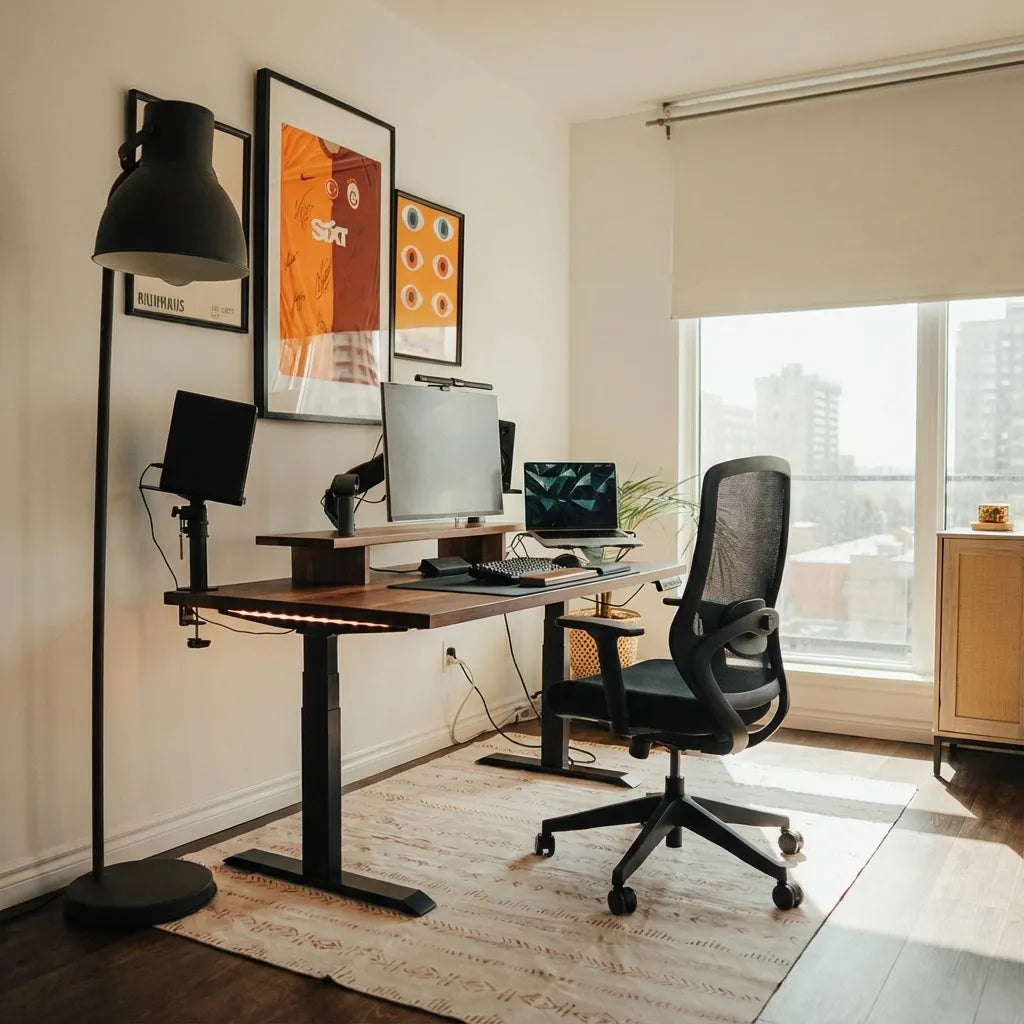



How Far Should a Desk Be From a Window?

In this article
How far should a desk be from a window? There is no single number that works in every room. The useful distance is the smallest clearance that lets the window, blinds and nearby equipment operate safely while keeping glare, heat, cold drafts and circulation under control. A fixed desk may need only enough room for a curtain and cleaning. A standing desk beside an operable window may need considerably more.
Measure the whole arrangement rather than the gap between two surfaces. Include the window handle, sill, trim, coverings, heater or vent, monitor, cables, moving desktop and the space a person needs to pass. Then test the workstation at the time of day when sunlight is strongest.
Quick answer: start with function, not a preset distance
Place the desk far enough away that you can fully operate the window and coverings, the monitor does not receive persistent glare, and the desktop cannot strike the sill, trim or hardware at any standing height. Keep baseboard heaters, radiators and floor vents unobstructed according to their instructions. If the desk faces the window, also preserve a comfortable viewing distance and avoid placing the screen directly against a bright background.
A mock-up is more reliable than a generic measurement. Mark the proposed desktop on the floor with painter's tape, add the chair movement zone, and test the window and blinds before moving heavy furniture.
What determines the right distance?
Window operation and cleaning access
An operable window needs space for its sash, crank, latch or inward swing. Curtains and blinds need to move without catching on a monitor or desktop. You may also need access to clean the glass, reach a screen or inspect condensation. Open and close everything before finalizing the desk location. If the window cannot be used as intended, the desk is too close regardless of the measured gap.
Glare and contrast
The Canadian Centre for Occupational Health and Safety recommends positioning workstations so windows are parallel to the worker's line of sight where practical and using blinds or curtains to control glare. A window directly in front of a monitor can create a bright background, while a window behind the user can reflect in the screen. Distance alone may not solve either problem.
Check the screen from the normal seated and standing positions. Look for reflections, squinting and a need to lean or rotate the display. Test in the morning and afternoon because the sun angle changes. Our guide to whether a monitor should face a window explains how orientation and coverings work together.
Heat, cold and airflow
Windows can create radiant heat, cold surfaces or drafts even when closed. Nearby baseboard heaters and radiators have their own clearance and airflow requirements. Do not use the desk as a screen over a heater or vent. Follow the building and equipment instructions, and keep paper, cables and furniture away from hot components.
If you feel a strong draft at the hands or face, move the working position before trying to compensate with a portable heater. Persistent condensation, water entry or unusual temperature should be addressed as a building issue rather than hidden behind furniture.
Standing desk travel
A height-adjustable desk changes the geometry. At sitting height, the desktop may clear the sill. At standing height, the monitor, arm or shelf can approach a window handle or trim. Cables and blind cords can also become trapped. Move the empty desk slowly through its full intended range while another person watches the rear and sides. Stop at any contact or cable tension.
The active Aspire Standing Desk Frame can support a flexible workstation, but the complete installed desk still needs a room-specific clearance test. Verify current dimensions and installation requirements on the product page.
Chair and walkway space
Moving the desk away from the window consumes room depth. Confirm that the chair can roll back without hitting a bed, wall or cabinet and that the desk does not narrow a route to a door. Measure the occupied workstation, not only the desktop. The best window gap is not useful if it creates a circulation problem elsewhere.
Three common layouts
Desk perpendicular to the window
This is often the easiest starting point for screen work because daylight arrives from the side. It can reduce direct contrast while preserving a view. Place the monitor so reflections are manageable and keep enough lateral clearance for coverings and window hardware. Our article on placing a desk perpendicular to a window covers this arrangement in detail.
Desk facing the window
Facing the window may feel open and pleasant, but the bright outdoor scene can sit directly behind the screen. Use adjustable coverings and avoid placing the monitor so close to the glass that it blocks operation or experiences extreme temperature. Check whether the sill forces the screen closer to your eyes than intended.
Desk with the window behind you
This layout can produce screen reflections. Rotate the desk slightly, add effective blinds or move the monitor rather than relying only on greater distance. A glossy screen may remain reflective even several feet from the glass.
How to measure your desk-to-window clearance
- Identify fixed obstacles. Mark the sill, trim, baseboard, heater, vent, outlet and window swing.
- Operate the window and coverings. Open them fully and note the space needed for hands and hardware.
- Place the complete workstation. Include the monitor, support, laptop, lamp and cable bundle.
- Set the viewing position. Arrange the chair, keyboard and monitor for comfortable work before optimizing the room gap.
- Test daylight. Check reflections and contrast at more than one time of day.
- Move the desk through its range. For an adjustable desk, test the lowest, highest and normal working heights.
- Test circulation. Sit, stand, roll back and walk past the occupied station.
What if the room is very small?
Prioritize safe operation and a usable working posture. A narrower desktop, a compact monitor support or a perpendicular layout may recover space without blocking the window. Do not compress electrical plugs, cover a heater or accept a screen position that forces constant glare merely to preserve an arbitrary furniture plan.
If the desk must sit directly in front of the window, our guide to putting a desk in front of a window provides a checklist for coverings, screen position and room use. A cardboard template can help compare desktop sizes before ordering.
Common mistakes
- Choosing a distance before testing the window handle and blinds.
- Checking glare only once on a cloudy day.
- Measuring the desk without the monitor or cables.
- Testing a standing desk at only one height.
- Blocking a heater, radiator or floor vent.
- Leaving no access for cleaning or condensation checks.
- Moving the desk into the chair or walkway zone.
The practical answer
Keep the desk as far from the window as the complete room requires, not as far as a generic rule suggests. The correct placement preserves window and blind operation, controls glare, respects heating and airflow requirements, clears the desk through its full travel and leaves enough circulation. Test the real workstation in real daylight. If one condition fails, change the orientation, coverings, desktop size or monitor support before accepting an awkward setup.
Sources: CCOHS, Lighting Ergonomics: Survey and Solutions; CCOHS, Lighting Ergonomics: Checklist.

Previous article
Why Is My Standing Desk Making a Clicking Noise?
Next article
Why Is My Standing Desk Making a Clicking Noise?